Curtis Vosti spent twenty-five years waiting for this train. He first worked on extending South Shore Line service into Munster back when he was on staff in the Hammond mayor's office, when the whole idea existed mostly on paper. On March 31, 2026, he and his wife Marisol finally boarded a train blocks from their Munster home and rode it north. "I worked on this project when it was just in the imagination stage," he told reporters that day.
That's the kind of quarter-century payoff that makes for a good ribbon-cutting story. It also raises the question every buyer, seller, and curious homeowner in Munster has been asking since: now that the train is actually running, what has it done to home values?
The honest answer is that nobody's numbers agree with each other. That disagreement, not the train itself, is the more useful thing to understand if you're trying to make a decision about property in this town right now.
Three Sources, Three Different Stories
Here's what the publicly available data shows for Munster in the months since Monon Corridor service began.
| Source | Metric | Reading |
|---|---|---|
| Zillow (Munster city-level) | Typical home value | $335,799, up 0.1% year over year |
| Zillow (46321 ZIP code) | Average home value | $358,575, up 2.2% year over year |
| Redfin | Average sale price | $385,000, up 5.5% year over year |
That's three readings of the same town, pulled from data providers that all claim to track the same thing as of mid-2026, landing anywhere from essentially flat to up more than 5 percent. One regional investment guide published in July 2026 went further still, putting Munster's year-over-year appreciation at 10.2 percent with a $375,000 median.
None of these sources is wrong exactly. They use different methodologies, different geographic boundaries, and different mixes of listings and closed sales. But if you're a buyer trying to decide whether Munster is appreciating quickly because of the new train line, the data itself won't settle it for you. And that's worth sitting with before you let a listing agent's talking point about "transit-driven appreciation" do your thinking for you.
What a Park-and-Ride Station Isn't
The instinct to expect a price bump isn't unreasonable. Sherri Ziller, president of the Northwest Indiana Regional Development Authority, made the case for exactly that kind of effect when the line opened, pointing out that "many of Chicago's suburbs have seen strong and enduring real estate development around Metra rail stations."
That's true, and it's also a comparison worth checking closely. Metra's premium suburbs built their price bumps around walkable downtowns, where the station sits inside a few blocks of shops, restaurants, and dense housing that make the train part of daily life rather than a once-a-week novelty.
Munster's two new stations don't look like that yet. The Munster Ridge station sits near Ridge Road and Manor Avenue. The Munster/Dyer station, the line's southern terminus, sits at 10412 Allison Road near the Munster-Dyer border. Both were built with the infrastructure a commuter line needs: parking areas, heated platforms, waiting shelters. Neither opened inside an existing walkable retail core, because Munster didn't have one at those exact intersections to build around.
That distinction matters for anyone pricing in a transit premium. The Metra suburbs Ziller is referencing built their value around proximity to a destination. Munster, for now, has built proximity to a parking lot. That's a real commuting benefit for someone who drives to the platform and takes the train from there. It's a different thing than the walk-to-the-station value that shows up in Chicago-suburb comps, and buyers who assume the two work the same way are applying the wrong mental model to this market.
The Real Line Drawn Through Munster
If station proximity isn't the thing splitting Munster's market, what is? The town's own subdivision history does a better job of explaining price variation than any distance-to-platform calculation would.
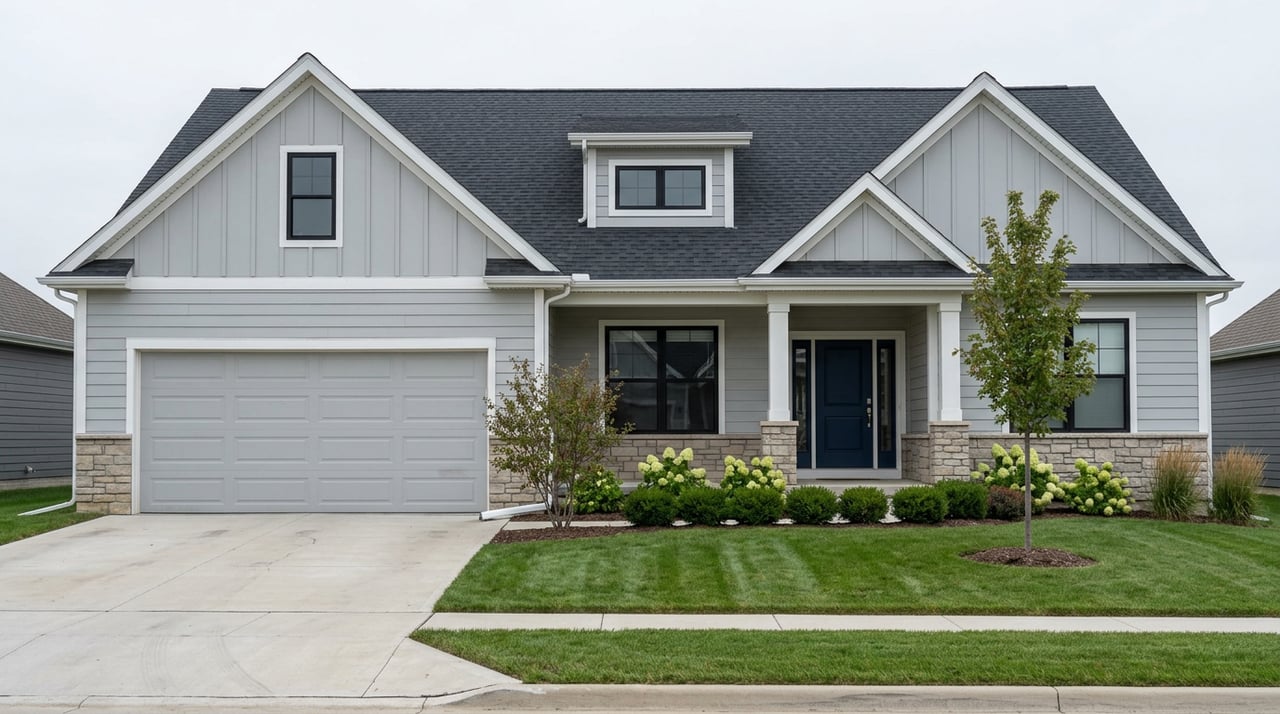
Munster's older subdivisions, places like Maynard, Fairmeadow, and Independence Park, were built from the late 1960s through the 1990s and represent the town's more modestly priced housing stock. Its newer construction, concentrated in subdivisions like West Lakes, runs larger and considerably higher priced. Layer in the town's established premium pockets, subdivisions such as White Oak Estates, Twin Creek, Cobblestones, and Centennial Village, and you get a map of Munster's price tiers that has nothing to do with which house is a ten-minute walk from Manor Avenue and everything to do with when the subdivision was platted and how large the homes are.
That's the line that actually predicts what a given address will cost in Munster right now. The train may eventually redraw it. It hasn't yet.
What the Line Actually Buys You
None of this means the Monon Corridor is irrelevant to your decision. It means the benefit it delivers today is a commute, not (yet) a guaranteed equity bump.
The ride itself is real and measurable. Travel time from the Munster/Dyer terminus to Millennium Station in downtown Chicago runs approximately 45 minutes to an hour, depending on how many intermediate stops your train makes. During weekday rush hours, several trains run direct to Chicago with no transfer required. Outside of peak times, you'll transfer at Hammond Gateway to reach the main Lakeshore Corridor line, a straightforward but real extra step worth knowing about before you assume every trip downtown is a one-seat ride.
Dyer, which shares the southern terminus station with Munster, is a useful comparison because its price data shows the identical pattern of disagreement. Redfin puts Dyer's median sale price at $311,000 for the three months ending May 2026. Zillow's April 30, 2026 snapshot shows a typical home value of $357,819 and a median list price of $351,617. Two data providers, two different pictures of the same town, in the same season the new line opened next door. If the contradiction were unique to Munster, you might chalk it up to a fluke in one dataset. Seeing the same split in the neighboring town that shares the exact same station makes it look more like a pattern in how these tools measure a market mid-transition than a signal about the train specifically.
What This Means If You're Comparing Munster to Somewhere Else
If you're weighing Munster against another Lake County town, or against staying in an Illinois suburb with an established Metra stop, here's the practical takeaway. Don't pay a premium for "close to the new station" as if it functions like proximity to a Metra downtown, because the retail and density that usually justify that premium haven't been built around either Munster stop yet. Do factor in the real commute math: 45 minutes to an hour to Millennium Station is a legitimate number to build a relocation decision around, whether or not it moves resale value in the next year.
And if you're evaluating a specific house, ask which subdivision it sits in before you ask how far it is from the platform. Right now, that's still the more reliable predictor of what you're actually paying for in Munster.
A Few Questions Worth Asking Before You Decide
Will Munster eventually build a walkable district around either station? Nothing in the current public record points to a specific retail or mixed-use project planned around Munster Ridge or Munster/Dyer stations. The Northwest Indiana Regional Development Authority has framed the corridor as a catalyst for future development in the region generally, but that's a regional statement, not a site-specific Munster plan.
How reliable is the 45-minute-to-1-hour commute estimate? That range comes from the South Shore Line's own reporting on travel time from the Dyer terminus to Millennium Station and depends on whether your train is a direct peak-hour run or a shuttle requiring a transfer at Hammond Gateway. Build in the longer end of that range if you're planning around an off-peak schedule.
Is school district reputation still driving Munster's demand more than the train? The available price data doesn't isolate that variable cleanly, but Munster's longstanding reputation for its school system predates the Monon Corridor by decades and remains a factor buyers cite independent of transit access.
If you're trying to figure out what a specific Munster address is actually worth, given its subdivision, its distance from the platform that matters least, and the commute time that matters most, that's exactly the kind of read a local eye is built for. Carol Allegretti has spent more than two decades in Lake County's neighborhoods, watching which price signals hold up and which ones are noise. Schedule a free consultation and get a straight answer before you make an offer based on a headline number that three different data providers can't even agree on.